
UCVM
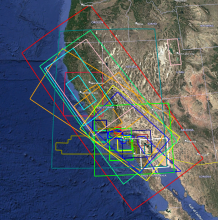
Description
UCVM is used to query seismic velocity models for earth properties (Vp, Vs, density) by longitude, latitude, and depth.
Models Available
CVM-H v15.1.1: The SCEC CVM-H velocity model describes seismic P- and S-wave velocities and densities, and is comprised of basin structures embedded in tomographic and teleseismic crust and upper mantle models. This latest release of the CVM-H (15.1.1) represents the integration of various model components, including fully 3D waveform tomographic results.
CVM-S4: CVM-S4 is a three-dimensional (3D) seismic velocity model of southern California developed by the Southern California Earthquake Center. The model consists of detailed, rule-based representations of the major southern California basins (Los Angeles basin, Ventura basin, San Gabriel Valley, San Fernando Valley, Chino basin, San Bernardino Valley, and the Salton Trough), embedded in a 3D crust over a variable depth Moho. Outside of the basins, the model crust is based on regional tomographic results. The model Moho is represented by a surface with the depths determined by the receiver function technique. Shallow basin sediment velocities are constrained by geotechnical data. CVM-S4 updates earlier versions of the model by determine upper mantle seismic velocity heterogeneities below Southern California from the inversion of teleseismic travel-time residuals. Teleseismic P-wave arrival times are obtained from three temporary passive experiments and Southern California Seismic Network (SCSN) stations, producing good raypath coverage. The inversion model element spacing is 20 km. S-wave velocities are determined from laboratory Vp/Vs ratios. The most prominent features imaged in the results are high P-wave velocities (+3%) in the uppermost mantle beneath the northern Los Angeles basin, and high-velocity anomaly (+3%) to depths of 200 km beneath the Transverse Ranges, crosscutting the San Andreas fault. It incorporates the upper mantle seismic velocity heterogeneities into the SCEC Southern California reference seismic velocity model.
CVM-S4.26.M01: CVM-S4.26.M01 is a 3D seismic velocity model based upon CVM-S4.26 which is a tomography improved version of the CVM-S4 model. CVM-S4.26.M01 preserves some of the geotechnical information in the original CVM-S4 model that was lost during the tomography improvements used to create CVM-S4.26. The CVM-S4.26.M01 model combines material properties from the CVM-S4.26 model by Chen et al (2011) together with near surface properties from the original CVM-S4 model. The goal of the CVM-S4.26.M01 model is to generate high resolution velocity meshes (<100m mesh spacing) for use in high frequency ground motion simulations from the low resolution CVM-S4.26 perturbation model. The CVM-S4.26 tomographic process imposed a minimum Vs of 1000m/s and it was performed on a 500m grid. The CVM-S4 geotechnical information is rule based and therefore arbitrary precision. The CVM-S4.26.M01 model integrates CVM-S4.26 perturbations while still honoring the CVM-S4 geotechnical layer (GTL) information in the top 350m. The desired effect is to recover the CVM-S GTL while smoothly adding in positive and negative perturbations of the CVM-S4.26 model. The M01 refers to the method developed to merge the arbitrary near surface information in the top 350m from CVM-S4 into the lower resolution (500m) properties from CVM-S4.26. Since the perturbations were calculated using a Vs minimum of 1000m/s, in certain areas of CVM-S (like boreholes), doing a straight trilinear interpolation of the perturbations with the CVM-S material properties can result in negative Vs and/or Vp values, so specific rules were introduced to avoid these issues. The resulting model, called CVM-S4.26.M01, implements rules to smoothly merge the near surface properties from CVM-S4 in the top 350m with the tomography improved model in CVM-S4.26. Below 350m, CVM-S4.26 and CVM-S4.26.M01 are expected to return identical properties.
Multi-Scale Statewide California Velocity Model: The Multi-Scale CALifornia (MUSCAL) statewide Vp and Vs velocity models provide high-quality integrated description of seismic structures across the state. Starting with the CANVAS base model (Doody et al., 2023), MUSCAL incorporates multiple regional and local velocity datasets into a unified structure, capturing features ranging from broad crustal-mantle structures to fine-scale local anomalies such as sedimentary basins. To ensure quality, the merged multi-scale models underwent a data-informed refinement process guided by simulations of small validation events. A key feature of MUSCAL is the inclusion of a locally optimized near-surface low-velocity taper (LVT), specifically designed to better represent under-resolved shallow structures and improve the accuracy of ground-motion predictions.
San Francisco Bay Velocity Model: The USGS San Francisco Bay Region three-dimensional (3D) seismic velocity model includes a detailed domain covering the greater San Francisco Bay urban region and a regional domain at a coarser resolution covering a larger region. Version 21.1 updates only the detailed domain with adjustments to the elastic properties east and north of the San Francisco Bay. There are no changes to the underlying 3D geologic model or the regional domain seismic velocity model. Version 21.1 of the detailed domain fits seamlessly inside version 21.0 of the regional domain without any jumps in elastic properties across the boundary between the two domains. The model was constructed by assigning elastic properties (density, Vp, Vs, Qp, and Qs) to grids of points based on the geologic unit and depth from the ground surface.
Contributing and Additional Documentation
UCVM GitHub repository
References
References, citations, and acknowledgements help us obtain continued support for the development of the UCVM software. If you use the UCVM software in your research, please include the citation of the UCVM paper in the references/bibliography section of your publication. This is more effective than you providing in-text acknowledgements.
- Preferred Reference: Small, P., Gill, D., Maechling, P. J., Taborda, R., Callaghan, S., Jordan, T. H., Ely, G. P., Olsen, K. B., & Goulet, C. A. (2017). The SCEC Unified Community Velocity Model Software Framework. Seismological Research Letters, 88(5). doi:10.1785/0220170082
- Preferred Software Citation: Small, Patrick E., Maechling, Philip J., & Su, Mei-Hui. (2022). The Unified Community Velocity Model (UCVM) (22.7.0). Zenodo. https://doi.org/10.5281/zenodo.7033687
- Example Acknowlegement: We would like to acknowledge the use of the SCEC Unified Community Velocity Model Software (Small 2022) in this research.